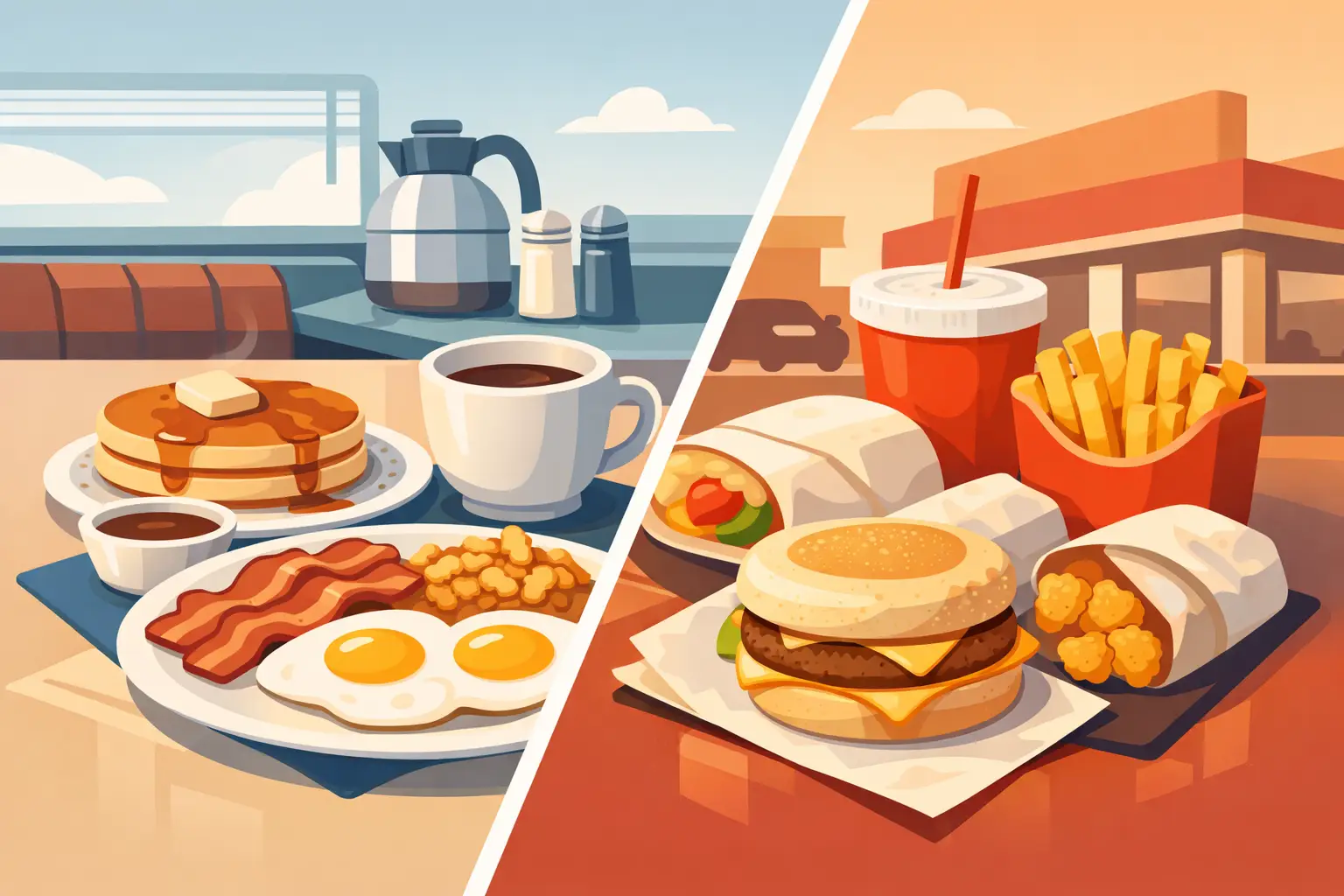
Some mornings, you need food in your hand before the next red light. Other mornings, you want a hot plate, fresh coffee, and a breakfast that feels like somebody meant it. That is really what diner breakfast versus fast food comes down to – not just speed, but what kind of start you want to your day.
For plenty of folks, both have their place. Fast food can get you through a rushed commute. A diner can turn breakfast into something steady, filling, and familiar. If you are deciding between the two, the real difference is not only what lands on the tray. It is taste, pace, value, and the kind of experience you remember after the meal is over.
Diner breakfast versus fast food: what are you really choosing?
At a glance, breakfast is breakfast. Eggs, biscuits, meat, coffee, maybe a side that rounds out the plate. But the gap between a diner meal and a drive-thru order shows up fast once you sit down and eat.
A diner breakfast usually gives you a fuller meal and a fuller experience. The food is made to be served hot and hearty. Portions tend to look like breakfast ought to look – generous, comforting, and worth slowing down for. You are not unwrapping a sandwich and hoping it holds you until lunch. You are getting a plate.
Fast food, on the other hand, is built for uniformity and speed first. That is not always a bad thing. If time is tight, convenience matters. But convenience has trade-offs. Breakfast made to move fast often tastes like it was designed around the clock instead of around the table.
Taste is where diners usually pull ahead
The first big difference is flavor. A diner breakfast has room for the little things that make a meal satisfying. Biscuits should taste fresh, not like they came from a holding cabinet. Eggs should feel like breakfast, not just protein packed into a wrapper. Coffee should invite a second cup.
That is why diners keep their place in towns that know good food. You can taste the difference between something prepared with care and something built to be identical at every exit ramp in America. A breakfast platter at a local diner is not trying to be the same as one served hundreds of miles away. It is supposed to feel rooted where you are.
In the South, that matters even more. Folks around here know the difference between a biscuit that is just there and a biscuit that anchors the whole meal. They know when breakfast feels hearty and when it feels processed. Fast food may be familiar, but a good diner breakfast is personal.
Speed is the fast food advantage – but not always by much
Let us give fast food its due. The drive-thru was made for busy mornings, early shifts, school drop-offs, and those days when every minute counts. If your goal is to grab something quick and keep moving, fast food often wins on pure convenience.
But that does not mean diners are slow. A well-run breakfast spot knows its crowd. Working folks, families, and regulars do not have all morning, either. In many local diners, breakfast comes out fast, the coffee stays full, and takeout moves just as efficiently as many chains.
So the question is not simply which one is faster. It is whether a few extra minutes gets you a much better meal. A lot of the time, it does.
Value is more than the lowest number on the board
Fast food often looks cheaper at first. A combo can seem like the easy budget choice. But value is not only about the sticker price. It is about what fills you up, what tastes worth paying for, and whether you are hungry again an hour later.
A diner breakfast tends to offer stronger value because the meal feels complete. You are more likely to get a real plate, more satisfying portions, and food that actually carries you through the morning. Paying a little more for a breakfast that sticks with you can be the better bargain.
There is also another kind of value that matters in a town like Cleveland. Spending money at a local diner supports a place with roots, history, and real connection to the community. That is different from feeding a national system. One keeps dollars circulating close to home. The other sends most of them on down the road.
The atmosphere changes the meal
This is where the biggest split happens, and it is one fast food cannot really close.
At a diner, breakfast comes with a sense of place. You hear the room. You see familiar faces. Maybe it is a weekday crowd grabbing coffee before work. Maybe it is a family easing into a Saturday morning. Maybe it is a retiree who has been sitting at the same table for years. That atmosphere is part of the meal.
Fast food is designed to keep things moving. There is nothing wrong with efficiency, but nobody gets nostalgic about a speaker box. A diner gives breakfast a human side. It feels lived in. It feels local. It feels like part of the town instead of just another stop.
For many people, that matters more than they realize. When life gets busy, a familiar breakfast spot offers something steady. Not flashy. Not trendy. Just dependable. That kind of comfort has real value.
Diner breakfast versus fast food for families and regulars
If you are feeding more than one person, the choice becomes clearer.
Families often do better at a diner because the meal feels less rushed and more flexible. People can order what they actually want, sit down together, and enjoy breakfast without balancing wrappers in a parking lot. The same goes for retirees catching up over coffee or friends meeting before the day gets going. A diner makes room for conversation.
Regulars notice something else, too – consistency with personality. The best local breakfast spots remember people, keep standards high, and make service feel genuine. Fast food can deliver consistency in a technical sense, but not in a personal one. There is a difference between being recognized by a place and being processed by a system.
That is part of what has kept historic diners meaningful for generations. They are not just selling breakfast. They are serving routine, memory, and community right alongside the plate.
When fast food makes sense
It depends on the morning.
If you are running late, traveling, or need the quickest possible option, fast food may be the practical call. Nobody has to pretend otherwise. Convenience is a real benefit, and sometimes convenience wins.
But if you have even a little room to choose, a diner breakfast usually gives you more of what people actually want from breakfast in the first place. Better flavor. Better portions. Better atmosphere. A better chance of starting the day satisfied instead of simply fed.
That does not make fast food useless. It just puts it in its proper lane. It is a backup plan, a hurry-up option, a quick fix. A diner is where breakfast still feels like breakfast.
Why local diners still matter
There is a reason longtime places earn loyalty that chains cannot buy. They become woven into the rhythm of a town. They serve generations. They hold onto recipes, habits, and a style of hospitality that feels rare once you have lost it.
In a place like Tennessee, that legacy means something. Folks remember where they had breakfast after ballgames, before work, after church, or on ordinary weekdays that became memories later. A local diner does more than feed people. It gives a town part of its identity.
That is why places like The Chef still stand out. A historic diner with Southern roots, fresh biscuits, and a breakfast served with love offers something bigger than convenience. It offers a sense of continuity. You are not just getting food. You are tasting history in a room that has seen a lot of mornings come and go.
So when you weigh diner breakfast versus fast food, think past the drive-thru clock. Ask what will actually satisfy you, what feels worth the money, and what kind of place you want to keep around. Some breakfasts get you through the morning. The best ones make you glad you showed up.